
Thought Leadership
What HR Leaders Need to Know About Succession Planning in 2026
Thought Leadership
By Molly Cohen
In 2026, workplace leaders are at a crossroads when it comes to succession planning. “We’re living in a time period where there’s a tremendous amount of instability and unpredictability, but all the internal practices around succession are really built around predictability and stability,” said David Reimer, CEO of The ExCo Group. “That creates problems for CHROs — you’ve inherited processes that have a rear-looking view, and you’ve got internal systems that need to evolve.” Reimer said he believes there’s a two-part alignment that needs to happen: Leaders need to understand what distinguishes their company’s leadership ecosystem, and they need to align on how they plan to continuously test this during times of change.
The State of Succession Planning
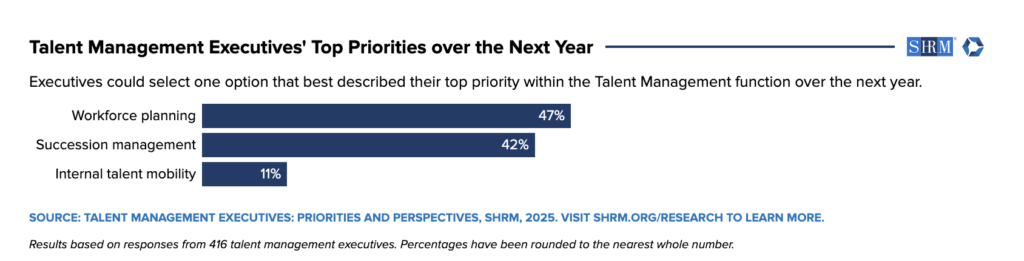
About 4 in 10 talent management executives (42%) cited creating a succession strategy as a top focus area for 2026, according to SHRM’s 2025 Talent Management Executives: Priorities and Perspectives research.
However, in 2025, just 22% of HR leaders reported that their organization had a formal succession plan, as reported in SHRM’s 2025 Talent Management Executives Benchmarking research.
This research indicates that the likelihood of succession planning correlates with company size: 16% of smaller organizations reported having a succession plan, compared to 44% of extra-large organizations.
The Challenges of Succession Planning in 2026
According to Reimer, the No. 1 succession planning challenge today is the macro-environmental disruption that started during the pandemic and has only continued to escalate.
“Consultants in succession planning have bodies of IP [intellectual property] in terms of skill matrices and competency sets that all benchmark against ‘What does it mean to be an effective CEO from 2000 to 2020?’ CHROs looking to shift the lens are having to do it on their own,” he noted.
Making a plan that works in the current environment of constant change means creating a new road map, which can be difficult for boards of directors.
“Boards are historically resistant to change,” Reimer said. “By their design, they are risk-averse — they are there to mitigate risk.”
Additionally, leadership buy-in continues to be a challenge due to leaders not understanding the purpose behind a succession plan. Transparent communication is critical to ensure leaders understand the “why” behind your plan.
“Succession planning, if driven by the HR team, tends to get this roadblock where leaders feel that it’s a matter of HR seeing them gone. A lot of it has to do not with HR’s bandwidth or HR understanding the importance, but needing to convince the leaders that it’s more about the organizational strength and the legacy of the leaders more so than it is about a replacement,” explained Prudence Pitter, global head of HR for Amazon Web Services’ Automotive, Manufacturing, and Business Development division.
How to Prepare for Succession Planning in 2026
HR executives and business leaders alike are facing a time of immense change.
“If you’re a CHRO today, you’re at a transformational intersection. That can feel like you’re being caught and pulled between the past and the future — because you are,” Reimer said. “This is a chance for you to reshape the way companies think about and build leadership. There’s almost never been a chance to make the kind of lasting difference that CHROs have today.” Reimer identified two priorities to focus on when it comes to identifying leaders for succession planning:
- Leaders need to have an enterprise view of the business.
- Leaders need to have a demonstrated track record of navigating change.
Many executives are skilled in their individual area of management but have difficulty understanding the big-picture strategy.
“Most organizations are still struggling with developing execs that truly have an enterprise view. They are incredibly good at their individual remit and may be partially good at partnering across the organization. Having someone who can also step back and speak about their entire enterprise strategy within their organization is a rare skill,” he said.
CHROs should look at potential leaders’ actual track records instead of attempting to assess for agility during an interview through scenario-based questions.
“Let’s not measure inspiration as a theoretical capability. We need to look for situations where the people we’re talking about for CEO can do these things and have done these things because we’ve given them a path or a stage to prove whether or not they can do it,” Reimer said.
When thinking through your succession plan, investing in external coaching can be worthwhile to make sure high-potential executives get the support they need. Having a degree of separation from the company can make the coaching more forward-focused. “When the coach is in the organization, there tends to be this blend of day-to-day operations and coaching the individual for the next level. When that coach is external, they are truly focused on developing for the next level,” Pitter said.
Signs of Change
The conversation around succession planning is changing among stakeholders. Over the last six months of 2025, boards have turned to CHROs more and more. “Increasingly, you’re having boards coming to CHROs and CEOs collectively and saying, ‘Given the degree of turbulence from regulatory, tariffs, supply chain, and you name it, can you convince us you’re building the next generation of C-suite leaders? Because we’re not sure anymore.’ Having that conversation come from the board makes it easier to innovate,” Reimer said. As we begin the first quarter of 2026, one thing is clear: CHROs have a unique opportunity to make a lasting impact on the leaders of the future. Driving succession planning is just the start.
The ExCo Group’s CEO, David Reimer, was featured in this article in SHRM.