ExCo Insights
Fumbi Chima’s Leadership Lessons | ExCo Insights
ExCo Insights
In this series, we explore some of the most important lessons and insights from our executive coaches and mentors.
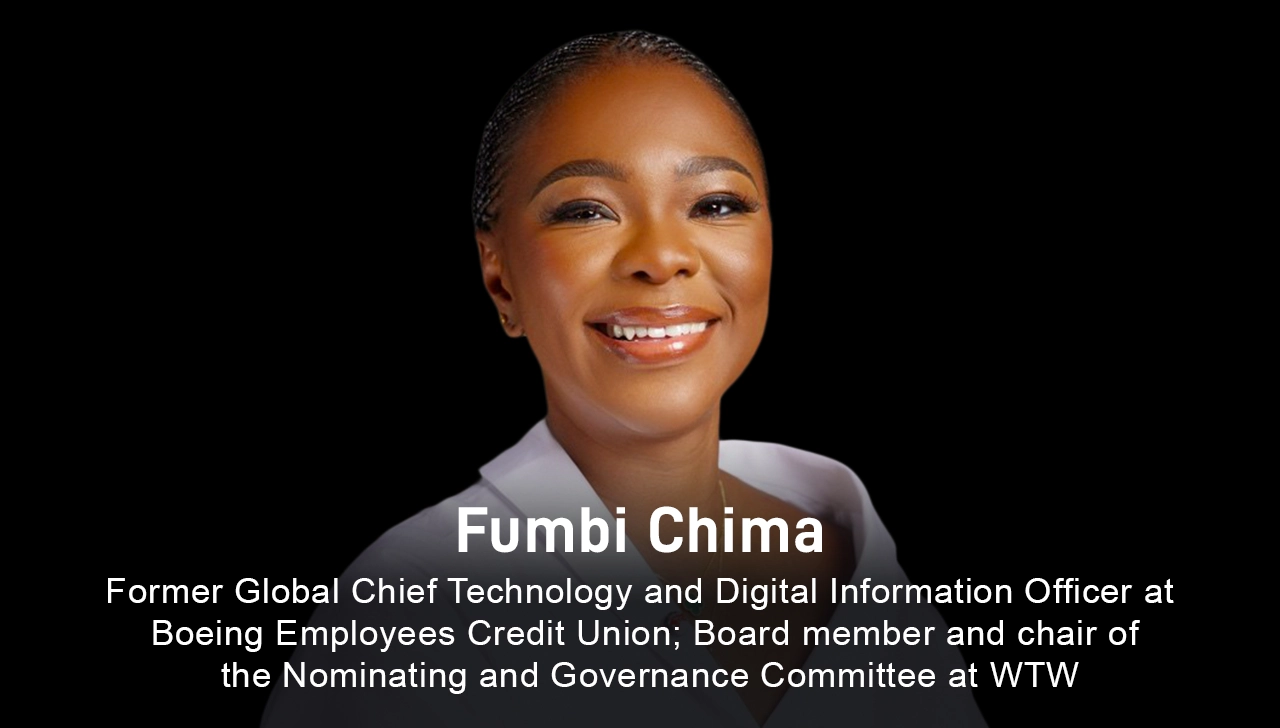
Fumbi Chima, an executive coach and mentor at The ExCo Group, former Global Chief Technology and Digital Information Officer at Boeing Employees Credit Union, and board member and chair of the Nominating and Governance Committee at WTW, shares her key leadership lessons. These include being able to admit failures, fail forward, and fail fast, as well as recognizing that your story and journey are essential when being an authentic leader.
Click here for more ExCo insights.
KEY LEADERSHIP LESSONS
The first one is about the importance of being able to admit failures. After all, everyone learns from mistakes, and as a leader, you need to be able to share those failings and those feelings with your team. As a leader myself, I had to be able to admit that I’ve made mistakes, and it’s okay. Because if I’m going to say that it’s okay for us to fail forward, fail fast, and that I’m going to forgive you when mistakes happen, then how are they going to believe it if I haven’t told you about my own experiences with failure?
I learned this from a leader I worked for earlier in my career. She often gave me feedback about how I needed to share more about myself, including the mistakes I had made. But this particular leader never told me that she had ever failed herself. In one year-end review, she gave me the feedback that I was a perfectionist. I disagreed, and I pushed back, saying that this doesn’t make sense.
“If I say that it’s okay for us to fail, how are they going to believe it if I haven’t told you about my own experiences with failure?”
And then, for the first time, she broke down and shared her life lessons, including how she got to where she was, and how she dealt with the feeling of always being put down. That was a turning moment for me. If she had shared that with me three years earlier, when we first started to work together, she probably would have gotten the best out of me. I didn’t know early on that she would have my back.
That was a pivotal moment for me. So, when I enter an organization as a new leader, I lead by example and tell people that we will have failures. I also say that I know how disappointing they can be, but that I want you to tell me first so that I can find a way to help cover you.
Another important lesson is about being your authentic self. I grew up in an era when you were expected to have two personalities—one at work and one at home. And being a woman, a woman of color, and a mother, I felt like that was what was expected of me. But it actually stifled my growth, because I was having to shift between two masks. And the higher up you move in your career, the more difficult it gets.
I strongly believe that you have to be able to merge them together and be proud. Your story, your journey, is important because people want to know who you are, and why they’re following you, and why they should believe in your vision. People want and need to connect with you as an authentic leader, so that people know what to expect.
The third leadership lesson is about being good at what you do and being confident about what you know. If you’re a domain expert, have the confidence to share the wealth of your knowledge.
WHEN I COACH CLIENTS, WE OFTEN TALK ABOUT…
One theme that comes up is about how to be more strategic as a leader. It’s about being curious and being able to see the big picture, in terms of the broader strategy and the forces impacting your industry. It also requires you not to be very territorial. When you’re a leader, you have to be able to work well with your peers, including how to give and take and when to let go. To deliver on the broader strategy, you need to be able to put the pieces together, and sometimes you don’t control all those pieces. One measure of being successful in doing that is when you start getting more people asking for your input.
Another common topic is how to move up in your career. I tell them that a big part of it is being able to navigate the unspoken rules that exist inside every organization, including being able to work with the style of their particular leader. If they are very collaborative and want a lot of discussion, then you have to allow more time to get to your point. But if your leader is more focused on action, that’s going to require a different style. As the context changes, you always have to be asking yourself how to bring everybody else along with you.