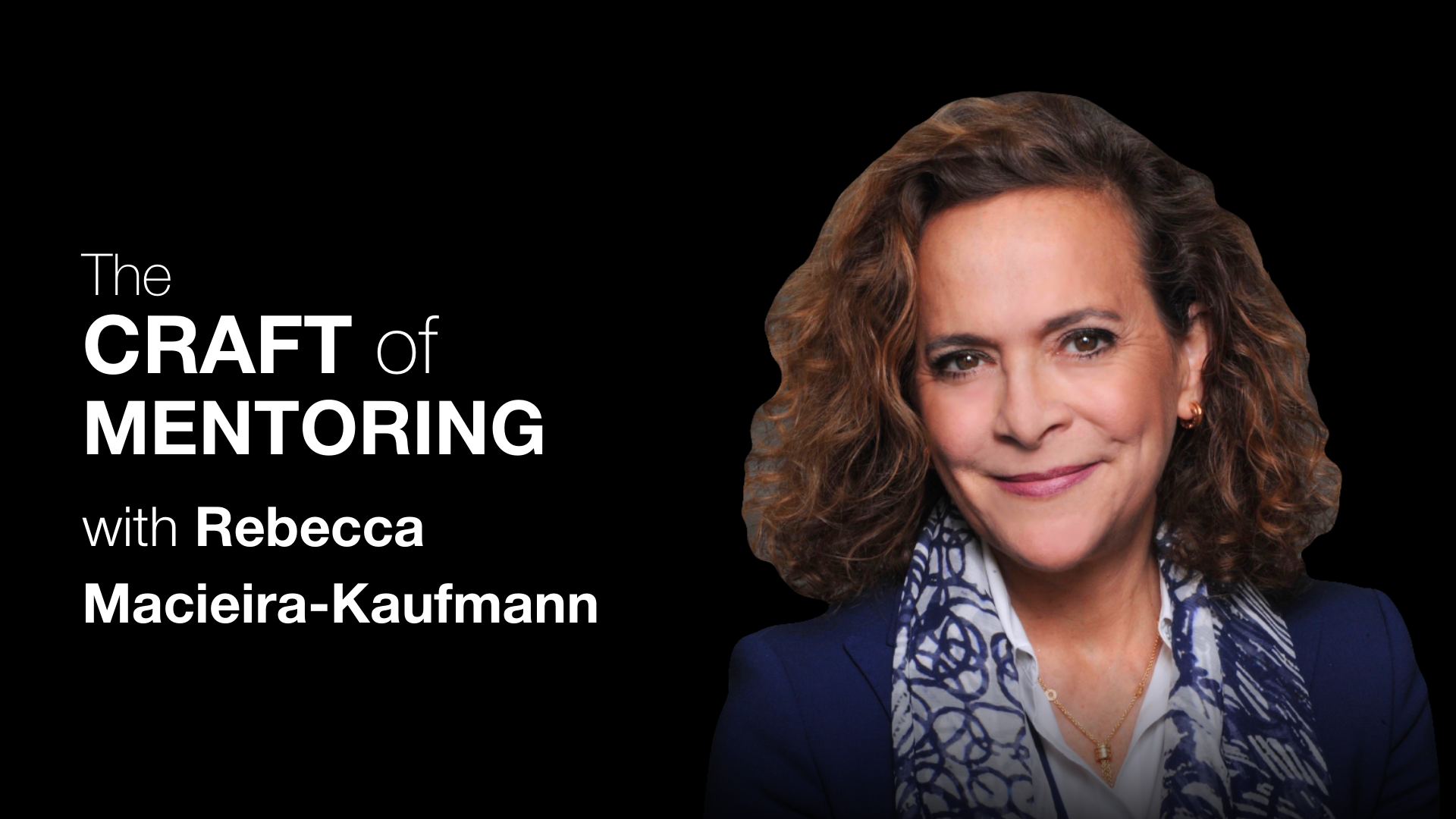
Rebecca Macieira-Kaufmann, former CEO of Banamex USA and former President of Citibank CA, and a mentor and coach at The ExCo Group, shares insights with Adam Bryant on the craft of mentoring. Key themes include building bespoke engagement frameworks around culture and strategy, developing stakeholder-management skills by avoiding assumptions, and staying true to your authentic self during challenging moments.
Q. What do you consider to be the secret sauce of mentoring?
A. It starts with the engagement being completely tailored to the client or the customer. It’s entirely bespoke, and it’s based on a deep understanding of their business and their ecosystem. The basis of everything is culture and strategy. That’s what leaders do—they drive and shape strategy, and they drive and shape culture.
Under those two, there are four areas that I like to explore. What are you doing for the client or the customer? What’s your team approach—how are you hiring, retaining, developing, and scaling your leadership? What is your operating-excellence cadence, which is really about execution. And then how are you delivering shareholder value, which is really about impact. That’s where I spend my time with clients, because it covers the entire business.
Q. What other tools or frameworks lead to the biggest unlocks?
A. One is the action plan that we develop early on in the engagement. We need to clarify the simple plan for their business overall, and then work on the simple plan for the client—to identify the key things that they need to do to raise their game and have greater impact in their role.
We also spend a lot of time thinking through each key stakeholder in their ecosystem. It’s about walking in the shoes of a peer, a boss, an employee, or a vendor. Sometimes that’s a big breakthrough when they realize they have a big blind spot with an important stakeholder.
Q. Building that stakeholder-management muscle is so important for these C-suite-level roles, and yet it doesn’t come naturally to a lot of people.
A. I agree. As just one example, I have a client who does not always assume positive intent about others, and therefore goes into meetings expecting to be frustrated before they’ve even had the discussion. And I’ve said to them, just ask for what you want. And they’re always so surprised when that works.
Because there’s so much going on in people’s heads sometimes before they even have the conversation. I call it playing tennis on both sides of the net. I try to get my clients to just stay on their side and let the other person hit the ball back, because the way they’re returning the ball might work perfectly well. But if you’re jumping over to the other side of the net and trying to return it for them—by making assumptions about what they are thinking or how they will react—that will hinder a relationship or discussion before it’s even started.
Q. But there are instances when people have shown their true colors time and again, and they are not trying to work to a win-win. What’s your advice to clients who have to work with people like that?
A. Take the high road and don’t go into the mud. You have to stay true to yourself and your values, because you retain your own power when you live your own values. So keep taking the high road. Someone can be slinging mud, but you should be up on a bridge watching them swim in the mud.
Q. Was there a lesson that you learned from a mentor yourself that has really stayed with you?
A. I had a mentor who gave me advice about what I should do when I was worried about something—it might have been a big decision I had to make, or whether I needed to do something differently with a new group I was taking over. She said, “Be you. And when in doubt, be more of you.” That has guided me my whole career.
The point is that you have wisdom. It’s inside you. People lose that wisdom when they’re just going in whatever direction the wind is blowing, and they lose focus and balance. In those moments, you have to go back to what you know to be true and what you can do.
Many people are swayed by social media and new trends. But that’s what they are—they’re trends. They’re not necessarily the answer to the problem at hand. So in those difficult moments, go back to being you, and being more of you. Trust your gut.
Q. What issues are coming up more often with your clients these days?
A. It’s not a new topic, but the emphasis is greater now on talent, talent development, developing a bench, and succession planning. Jobs are so fluid, and people are changing roles and changing companies more often.
And these conversations around talent are of course related to AI and data. What are the skills needed for the future? How do you develop a talent pool to be productive innovators. This transformation is so much about the future of work.
Recent