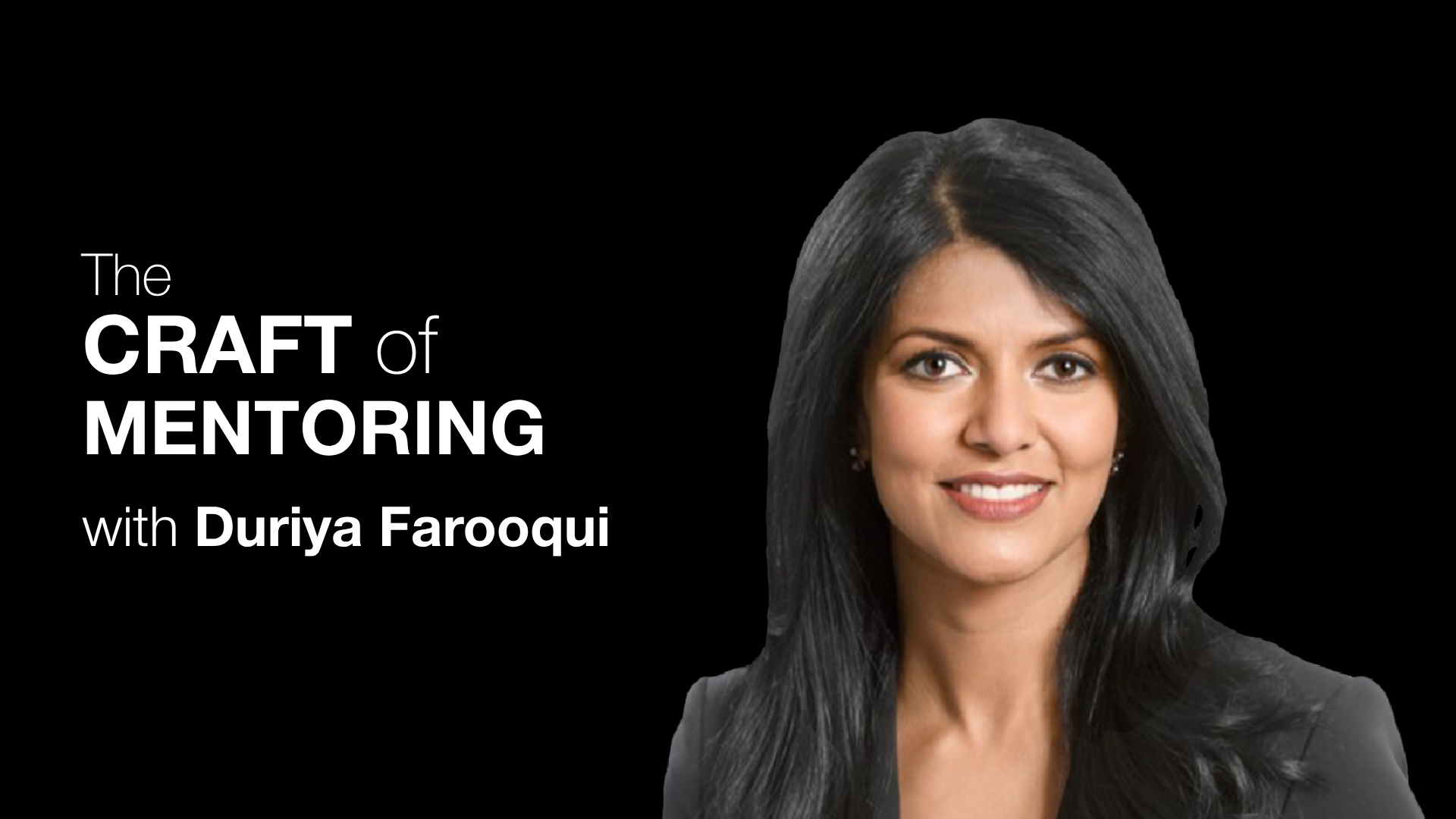
Duriya Farooqui, Board Director at Intercontinental Exchange and mentor and coach at The ExCo Group, shared sharp insights with Adam Bryant. Key themes include challenging the assumptions leaders carry about themselves, the “judgment premium” that separates good leaders from great ones, and why being willing to take on anything – regardless of role or remit – is what transforms a manager into an enterprise leader.
Bryant: What do you consider to be the keys to effective mentoring?
Farooqui: The most powerful thing you can do as a mentor is to get people to challenge their assumptions about themselves and their assumptions about others. People tend to develop talk tracks in their heads over time. Sometimes they underestimate their capacity, and sometimes they overestimate what they’re ready for, based on the feedback they’ve gotten over the years.
I often say to my clients that my job is to figure out what’s written on their back – the feedback that won’t show up in an evaluation but may be a barrier to them getting that next leadership role. Because once you get to the C-suite, how you show up as a leader becomes exponentially more important. What do you do under stress? Can you build talent, and how well can you inspire, push teams, and hold them accountable?
Bryant: How do you challenge people to rethink those talk tracks they have about themselves?
Farooqui: It’s important to get objective feedback so that they are grounded in the reality of how others perceive them, rather than what they think. We do interviews with people who work directly with our clients, and it often happens that their observations are completely inconsistent with how my client sees themselves.
Trying to get our clients to reconcile and internalize those differences can be the hardest conversation. In one case, I was coaching a high-performing client who was a bull in a china shop. He could drive transformation and business results but was viewed as having an inflated ego and always talking about himself.
For that reason, it was unlikely that he was going to get the next role. So I said to him, “You’ll be voted into your next job. If your peers don’t envision being able to work for you, chances are very low that you will get the promotion. And it won’t be because you’re not a great business performer. It will be because your peers would rather work for someone other than you.”
That flipped a switch for him that he needed to do a better job of engaging his peers and winning them over, rather than showing up as a competitor. Peer engagement and followership are so important at the C-suite level, especially if you want to be a CEO.
Bryant: Is there a tool or framework that you find reliably leads to the biggest unlocks when you work with clients?
Farooqui: The most impactful tool for developing trust and understanding what motivates my clients is the lifeline exercise, in which they share the highs and lows of their lives, starting from an early age. I always get deep insights about my clients from that conversation – what inspires them, what they value, and what their derailers are.
I also like to talk about stakeholder management and to push my clients to think about what motivates their stakeholders and how my client can help them. That understanding and intentional approach can help them build a constructive working relationship with their key stakeholders, so that everyone can accomplish their goals.
Bryant: What’s the best lesson you learned from one of your mentors over your career?
Farooqui: I was given the advice early in my career to be the person in the room who can accomplish anything. I didn’t realize it at the time, but it immediately put me in an enterprise mindset, so that I was unafraid to take on a challenge that was outside my role and my remit.
I went from being a senior manager to being the chief operating officer of an organization in a span of four years. I was able to do that because I chose to lead on challenging topics and initiatives, including things that other people weren’t willing to own and drive. Not being afraid of tackling something new totally changed the trajectory of my career. It made me a general athlete and an enterprise leader.
Bryant: Can you share an early influence that shaped who you are as a leader today?
Farooqui: When I was young, my dad said something to me that defined so much of how I think about my career journey and how I tend to live life. He said, “You can be whatever you want to be in life. But whatever you choose to do, you have to be the best at it, because there is no room in this world for mediocrity, none.”
Bryant: Given all the disruption in the world, how do you help your clients not feel overwhelmed?
Farooqui: First, you have to take the context as a given and then focus on what you can control and where you can manage risk. And I often talk about the “judgment premium” that sets the best leaders apart. The difference between a good leader and a great leader is how you exhibit judgment in a context where change is a constant. The ability to stay focused, while maintaining agility in a highly adaptive environment, is critical.
Second, it’s important to have strategic clarity around the bets you are making and prioritize execution around them. And third, leaders need to have a future-focused mindset and lean into the emerging forces that will shape the future. How is AI going to shape how companies operate and the workforce of the future? How are you thinking through that with a long-term view as well as a short-term adaptive view? The CEOs who can shepherd their companies across that terrain are the ones who will emerge as winners.
Recent